- Almost every camera drone must be registered with CAASL, and each operation needs CAASL approval plus Ministry of Defence security clearance.
- Normal limits are 150ft (45m) above ground, visual line of sight, daylight only and no flying within 5 miles of an aerodrome without permission.
- Archaeological sites, sacred sites, national parks, crowds and restricted areas need special approval, and temporary bans can apply during festivals.
- Travellers can apply online well before arriving or hire a registered local operator, and should check the latest process with CAASL.
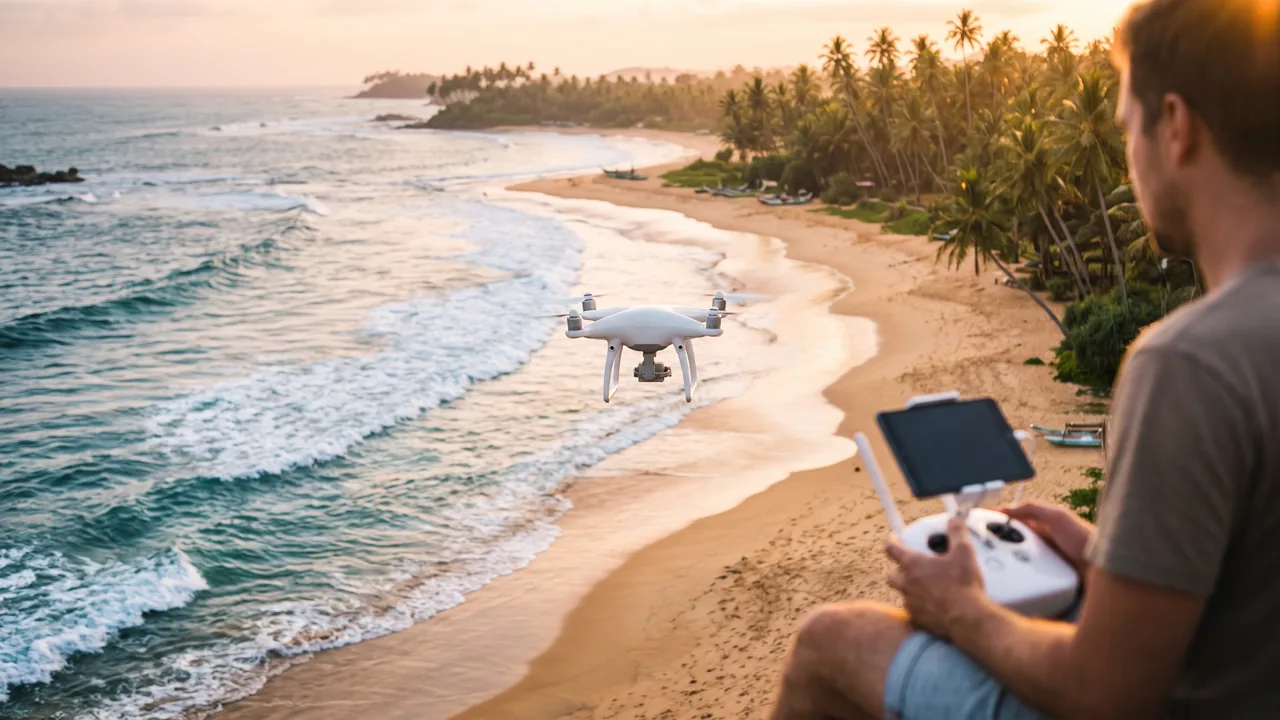
Yes, you can fly a drone in Sri Lanka, but only with approval. Almost every camera drone must be registered with the Civil Aviation Authority of Sri Lanka (CAASL), and each flight needs CAASL approval plus security clearance from the defence authorities, even for holiday filming. Travellers can apply online before they arrive, or hire a licensed local operator who already holds the paperwork.
This guide sums up what the official sources say as of November 2026, what we could not confirm, and practical tips for travellers and for hotels and villas that want aerial footage. It is general information, not legal advice. Rules and procedures change, so always check with CAASL before you fly.
Who regulates drones in Sri Lanka?
Three bodies matter most:
- CAASL sets the rules in its Implementing Standard SLCAIS-053, registers drones and gives airspace approval for each operation.12
- The Ministry of Defence issues security clearance for applications that CAASL forwards to it.4 CAASL describes this clearance, through the Office of the Chief of Defence Staff, as mandatory.1
- Site owners and other authorities, such as the Central Cultural Fund for sites like Sigiriya, may need to give their own permission.9
In March 2026 the Sri Lanka Air Force publicly reminded local and foreign people that flying without proper authorisation is "strictly prohibited".6
Do I need to register my drone?
Almost certainly. CAASL's FAQ says all drones must be registered except those that weigh less than 200g and carry no data-capturing device such as a camera.3 That means even small "under 250g" camera drones need registering. The Implementing Standard adds that a pilot who is not a Sri Lankan citizen can only get a temporary registration, valid for a limited period.2
Registration is not the same as permission to fly. CAASL's FAQ is clear that a registered drone still needs CAASL approval for every operation, "irrespective of the purpose".3 If you want to fly somewhere not covered by your approval, you must apply again for the new location.3
How tourists apply
CAASL says visiting tourists who use a drone temporarily do not need to follow the import process for drones brought in permanently. Instead, they should apply through its online portal.1 Based on CAASL and Ministry of Defence guidance, expect to provide:
- An online application with your drone's details and the exact locations, by address or GPS coordinates.4
- A copy of your passport bio page.4
- Third-party liability insurance. CAASL requires it, and the minimum cover rises with the drone's weight.13
- Consent from the owner of the land you will fly from or over.14
The Ministry of Defence processes applications on working days only, and says it may take longer if other agencies need to approve.4 We could not find an official processing time or an official fee for tourist approvals, so apply several weeks before your trip and do not rely on getting a last-minute answer.
In late 2025, the Sri Lanka Tourism Promotion Bureau announced it would help foreign content creators get approvals for tourism promotion filming, coordinating with the Ministry of Defence and CAASL.12 We could not confirm how that service works in practice, so ask the bureau directly if it applies to you.
What about customs at the airport?
This is the part we could least verify. Sri Lanka Customs publishes a process flow for clearing drones, but it dates from 2021 and is aimed at imports.11 CAASL's current guidance says tourists flying temporarily should use the online approval route rather than the import process.1 We found no current official page describing what happens to a tourist's drone at the airport. Travellers' accounts vary, so carry printed copies of your CAASL approval, security clearance and insurance, and check with Sri Lanka Customs before you travel.
The main flying rules
These come from SLCAIS-053 (1st edition, revision 03, January 2022) and CAASL's FAQ:23
- Height: no higher than 150ft (45m) above ground level, unless specially approved.
- Line of sight: you must keep the drone in direct sight at all times, and below the cloud base.
- Airports: no flying within 5 miles of an aerodrome boundary without permission.
- Daylight: no flying from 20 minutes after dusk to 20 minutes before dawn, unless specifically authorised.
- Take-off point: normal operations may not be flown from a rooftop, elevated ground or a moving vehicle.
- People and property: stay well clear of people, animals and property, and get the owner's or occupants' consent before flying over property.
- Without special approval, do not fly: over crowds or public gatherings, congested areas, roads or railways, near power lines or communication towers, or over national parks, archaeological sites, protected areas or security establishments.
No-fly zones and sensitive places
The Ministry of Defence says no drone may fly in restricted areas shown on the SL FlyRight map, and that a normal security clearance does not cover them. Restricted-area flights need a special request at least 14 days ahead.4 We could not access the map itself, so ask CAASL to confirm whether your location is affected.
Archaeological sites and wildlife sanctuaries need prior approval and a no-objection letter from the authority in charge.4 For Central Cultural Fund sites such as Sigiriya, Polonnaruwa and parts of Anuradhapura, the Fund's filming guidelines list letters from the Ministry of Defence, CAASL, the Air Force and other bodies for aerial filming.9 In Galle Fort, the heritage authority says drone filming needs CAASL permission.10
Religious sites and festivals deserve extra care. In 2021, police arrested a foreign visitor for flying a drone over the Temple of the Tooth in Kandy without permission.8 In 2025, CAASL suspended all drone flights over the Kandy Esala Perahera route during the festival.7 Temporary bans like this can appear at short notice.
Commercial filming
Flying for hire or reward needs special written approval from CAASL's Director General, decided case by case.2 For commercial jobs, the Ministry of Defence also asks for a client request letter, no-objection letters from the property owner and, for public areas, the police. It warns that commercial work must not be declared as leisure.4 CAASL is also bringing in a licensing system for professional drone pilots, with theory and practical tests, a medical examination and security clearance.5 We could not confirm a start date.
What happens if you break the rules?
Breaking the Implementing Standard is an offence under the Civil Aviation Act. Police may detain the operator, and CAASL may direct police to seize the drone.2 We could not find official fine amounts, so we have not quoted any. Tourists have been arrested in recent years for unauthorised flying.12
Options for travellers
You have two realistic choices:
- Register and apply yourself. Best if you are staying a while, filming in only a few places, and can apply well ahead. Plan your locations first, because each approval is tied to specific sites.
- Book a licensed local operator. Better for one-off shots, such as a wedding or a villa stay, or if your dates are close. A local operator should already hold registration, insurance and experience of the clearance process. For example, this site offers a drone videography service in Sri Lanka, and there are other registered operators too. Whoever you hire, ask to see their CAASL approval for your location and date.
Either way, leave the drone in your bag at airports, military areas, temples and festivals unless you have specific written approval.
Tips for hotels and villas commissioning aerial footage
Aerial shots show what photos from the ground cannot: how close you are to the beach, the shape of the pool, the paddy fields or jungle around you. That context helps guests decide. Good footage can be reused across your website, Google profile and social media content for years.
- Sort permissions early. The operator applies, but you will usually need to sign a consent or no-objection letter as the property owner. Neighbouring land, public beaches and roads may need extra permission.
- Protect guests' privacy. Film on a quiet day, tell in-house guests in advance, and keep the drone away from occupied rooms, pools and private gardens. Use models or staff rather than identifiable guests, and get written releases from anyone who appears.
- Plan for the light. The hour after sunrise and the hour before sunset give soft, warm light and long shadows. Remember the rules stop flying from 20 minutes after dusk.2 Midday sun works for showing clear water and pool colour.
- Mind the weather. Drones struggle in strong wind and rain, so on monsoon coasts, book a few backup dates.
- Brief the shot list. List the shots you need, for example an approach to the entrance, a reveal of the beach and a slow pass over the pool, so the flight time is used well.
Frequently asked questions
Can tourists fly drones in Sri Lanka?
Yes, but only with approval. Tourists apply through the Civil Aviation Authority of Sri Lanka's online portal, which also involves a Ministry of Defence security clearance, third-party insurance (required for most drones) and consent from the landowner. Non-citizens can only get a temporary registration. Apply several weeks before travelling, because applications are handled on working days and some take longer.
Do I need to register a drone under 250g in Sri Lanka?
In most cases, yes. The Civil Aviation Authority of Sri Lanka says only drones that weigh less than 200g and carry no camera or other data-capturing device are exempt from registration. Most small travel drones weigh more than 200g and all have cameras, so they need registering and an approval before each operation.
How high can I fly a drone in Sri Lanka?
The normal limit is 150ft, or about 45m, above ground level. Higher flights need special permission with conditions. You must also keep the drone in direct line of sight, below the cloud base, and stay at least 5 miles from airport boundaries unless you have permission. Night flying needs specific authorisation.
Can I fly a drone at Sigiriya or the Temple of the Tooth?
Not without special approval. Archaeological and sacred sites need prior permission and a no-objection letter from the authority in charge, on top of the usual Civil Aviation Authority and defence clearance. A visitor was arrested in 2021 for flying over the Temple of the Tooth without permission, so do not risk it.
Sources
- Civil Aviation Authority of Sri Lanka, Drones: online approval system and manual applications, accessed November 2026.
- Civil Aviation Authority of Sri Lanka, Implementing Standard SLCAIS-053, 1st edition, revision 03, January 2022.
- Civil Aviation Authority of Sri Lanka, Drone FAQs, accessed November 2026.
- Ministry of Defence Sri Lanka, Drone security clearance applications, accessed November 2026.
- Daily Mirror, Sri Lanka to become second in South Asia to license drone pilots, January 2026.
- Daily Mirror, Sri Lanka Air Force warns against unauthorized drone use, March 2026.
- Daily Mirror, Drone operations over Perahera route suspended during Perahera days, August 2025.
- News First, Foreigner arrested for flying drone over Kandy, November 2021.
- Central Cultural Fund, Guidelines to get permission for motion filming and still photographs, December 2021.
- Galle Heritage Foundation, Filming and photography permission, July 2025.
- Sri Lanka Customs, Process flow for issuance of clearances of drones or UAVs, November 2021.
- Daily Mirror, Tourism Bureau to streamline drone use for foreign tourists, October 2025.